"How much is an implant?" is the first question most patients ask, and a perfectly fair one. Answering it with a single number, however, is misleading: an implant is not one product with fixed specifications but a treatment plan made of stages and components, with additional procedures depending on your bone and gums. The gap between two quotes may reflect a genuine difference in quality and warranty — or simply a difference in what each includes.
What makes up the cost
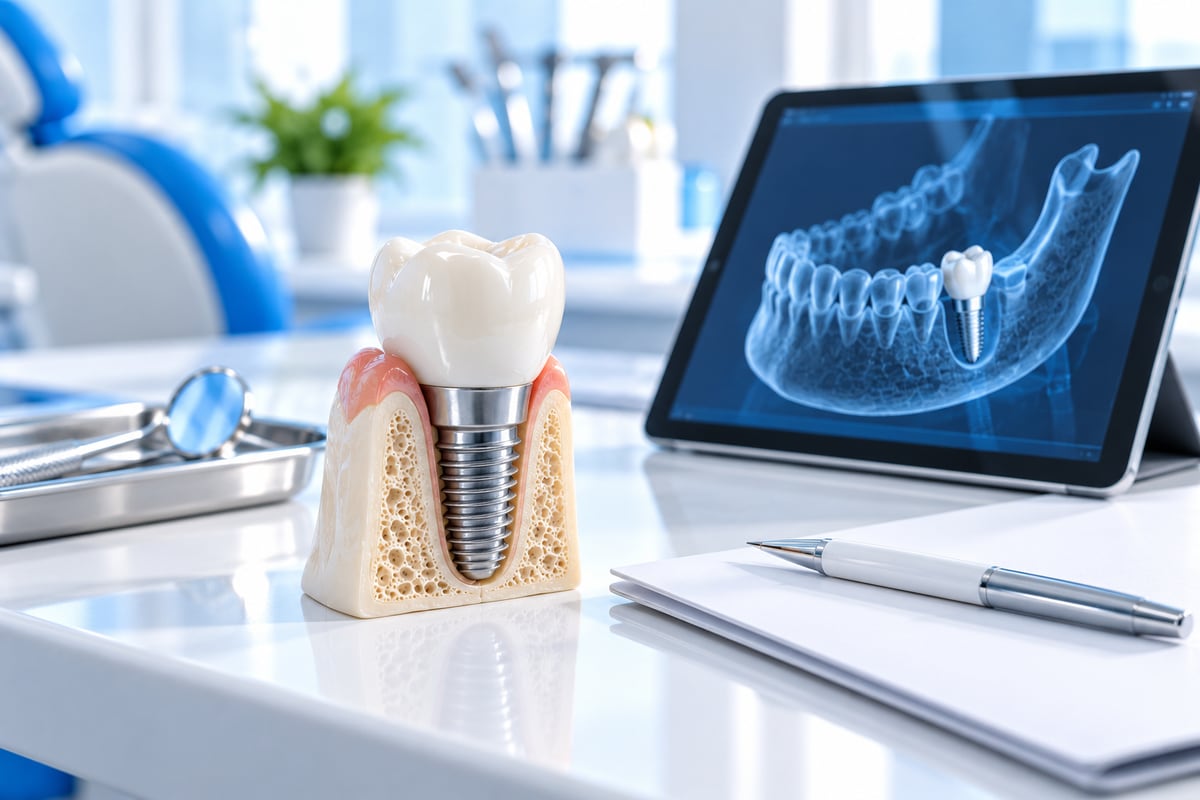
- 1 Assessment and diagnosis: clinical examination, panoramic imaging and often a CBCT scan to measure bone and locate the nerve and sinus.
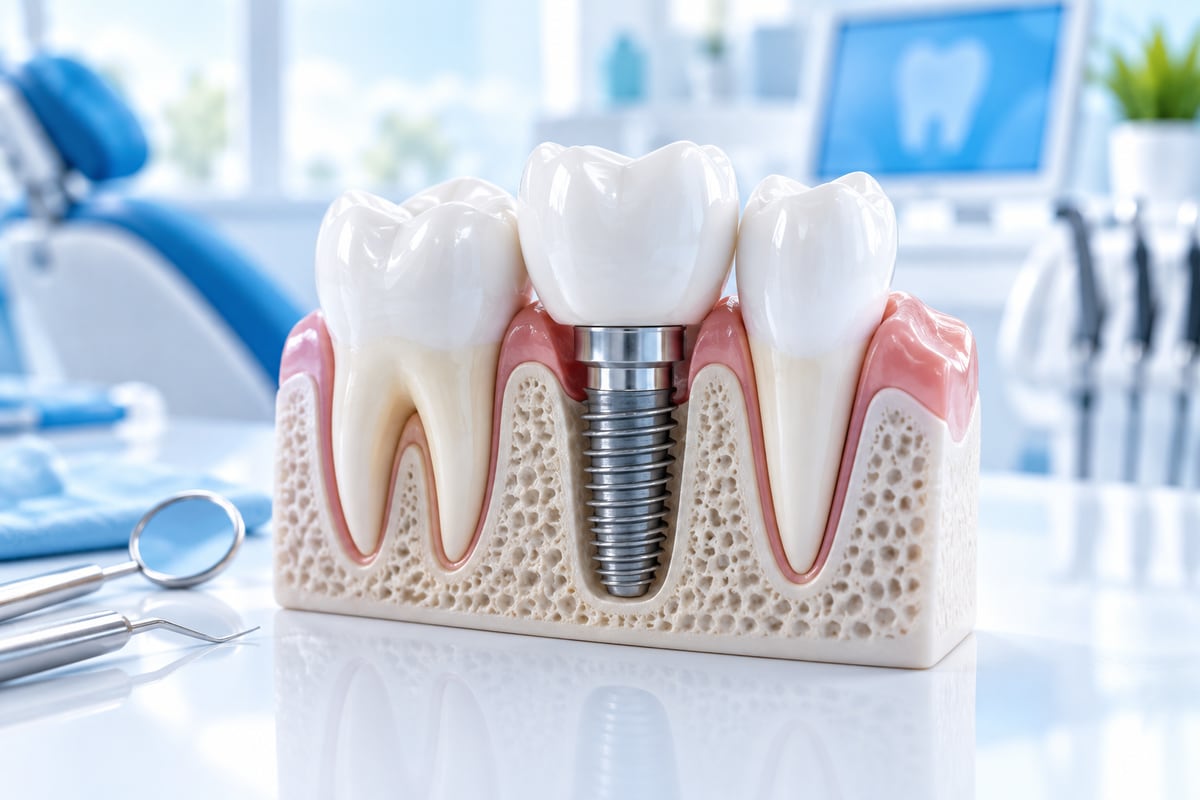
- 2 The fixture itself, whose price varies greatly with the system used.
- 3 The abutment connecting fixture to crown — stock or custom-made, the latter more precise and more expensive.
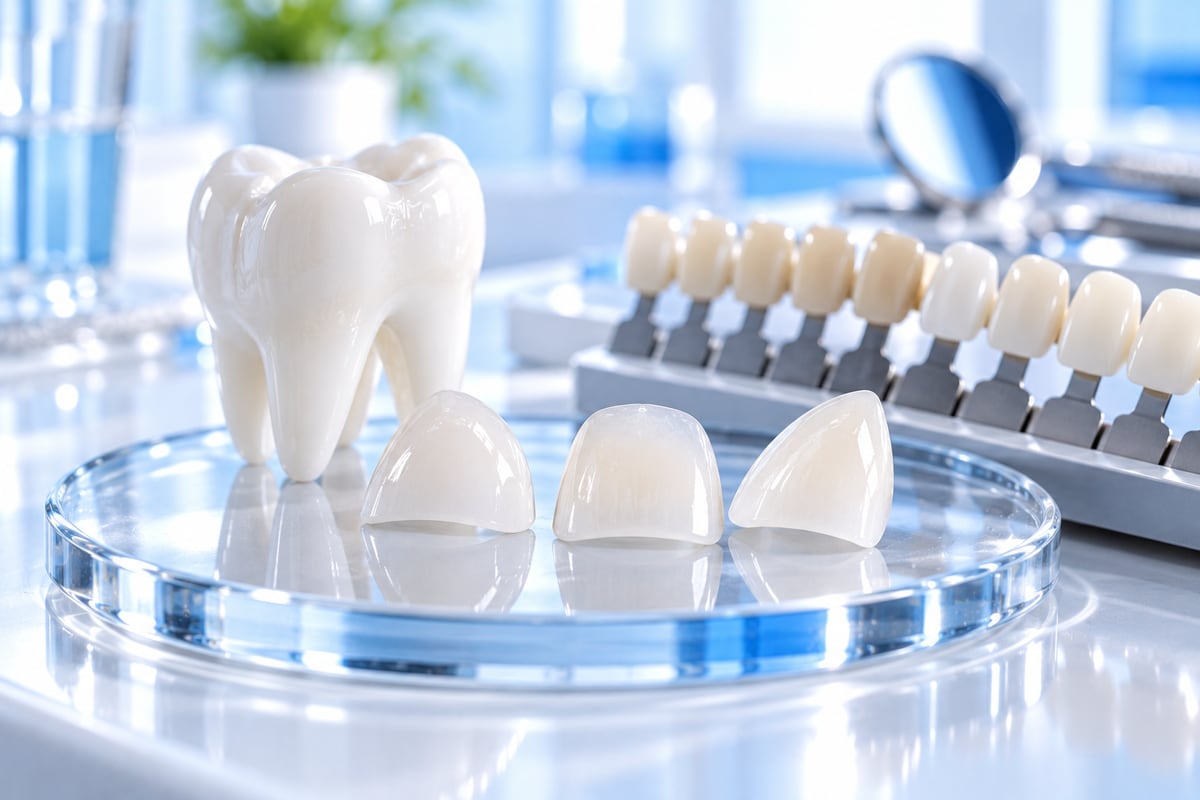
- 4 The final crown, usually zirconia or porcelain-fused-to-metal; see types of dental crowns.
- 5 Additional procedures where needed: bone graft, sinus lift, soft-tissue graft, or an extraction first.
- 6 A temporary tooth during healing, especially in the front region.
- 7 Follow-up visits and subsequent radiographs, which are part of the plan rather than extras.
Why implant systems differ in price
- Research and documentation: major systems have twenty to thirty years of follow-up data; inexpensive newer systems often have none.
- Surface treatment: the microscopic surface affects the speed and quality of osseointegration.
- Manufacturing precision: an accurate fixture-abutment fit reduces micro-gaps where bacteria accumulate.
- Long-term component availability: if you need a new abutment or crown in seven years, does the system still exist?
- Formal warranty through a local distributor has real value.
Procedures that increase the cost
Bone grafting is needed when width or height is insufficient — common in people who lost a tooth years earlier, since bone resorbs after loss. It may be minor and done at the same visit, or extensive with a separate procedure and four to six months of healing. Sinus lifting creates height in the upper back jaw. Soft-tissue grafting matters aesthetically in the front, where the gum contour decides whether the result looks natural. And if the tooth is still present, extraction with socket preservation is a separate cost that often reduces a larger cost later.
Comparing two quotes fairly
- 1 Does the price include fixture, abutment and final crown, or the fixture alone?
- 2 What is the implant system and country of origin, and is there a local distributor?
- 3 Is CBCT imaging included if required?
- 4 Is bone grafting or a sinus lift likely, and at what cost?
- 5 What material is the final crown and which laboratory makes it?
- 6 Is a temporary tooth included during healing?
- 7 How many follow-up visits and radiographs are covered?
- 8 What is the written warranty and what voids it?
- 9 Is a written treatment plan provided before payment?
By the end of that list the gap between two quotes is usually not what it first appeared. Sometimes the higher quote is genuinely cheaper because it is comprehensive — the point is to compare like with like.
The ten-year calculation
Most comparisons stop at today's price, while a sound decision looks at ten years. A bridge costs less initially but requires preparing two intact teeth; years later, decay or pulp inflammation under one abutment can cost you the whole bridge and involve three teeth instead of one. An implant costs more initially but leaves the neighbouring teeth untouched and preserves the bone that otherwise resorbs. That does not make implants always right: if the adjacent teeth genuinely need crowns anyway, a bridge solves three problems in one and becomes the economical choice. Ask your dentist directly: in my position, which would you choose and why?
What voids a warranty
- 1 Missing the six-monthly maintenance visits that detect peri-implant inflammation early.
- 2 Poor oral hygiene, the leading cause of losing an implant after initial success.
- 3 Heavy smoking, explicitly excluded by some warranties.
- 4 Uncontrolled chronic disease, especially diabetes.
- 5 Not wearing a night guard if you grind.
- 6 Modification of the restoration by another clinician without coordination.
Ask for the warranty in writing within the treatment plan, and clarify whether it covers the fixture only or the crown too, and whether it includes the cost of redoing the work or only the component.
When implants are not suitable
- Uncontrolled diabetes — a temporary contraindication until control improves.
- Heavy smoking, which raises failure risk rather than forbidding treatment outright.
- Active gum disease, which must be treated first.
- Bisphosphonates, particularly intravenous, requiring careful assessment.
- Previous radiotherapy to the jaws, needing specialist evaluation.
- Adolescents before jaw growth is complete, since an implant does not move with growth.
Time, not just money
- 1 Assessment visit: 30–45 minutes with examination, imaging and plan discussion.
- 2 Placement: 30–60 minutes per implant under local anaesthesia.
- 3 Healing: two to four months, longer after extensive grafting.
- 4 Exposure and impressions: a short, simple visit.
- 5 Fitting the final crown: one visit after laboratory work.
- 6 Review one week later, then every six months.
Selected cases allow immediate placement at the time of extraction, sometimes with an immediate temporary tooth, but this depends on primary stability and the state of bone and gum. Do not choose a clinic because it promised "teeth in a day" before seeing your scan.
Full-arch implants
A jaw with no salvageable teeth does not mean fourteen implants. Modern practice uses a limited number of fixtures carrying a full restoration: a fixed bridge on four or six implants, feeling close to natural teeth; an overdenture retained by two to four implants, removable for cleaning but far more stable than a conventional denture; or a conventional denture, cheapest but resting on gum while bone continues to resorb. In selected cases a fixed temporary can be placed soon after surgery. The deciding factor is the remaining bone volume, which a CBCT scan determines — not a visual examination.
Dental tourism
Egypt receives a growing number of patients from abroad for dental care, for real reasons: significantly lower cost than Europe or the Gulf, well-trained clinicians and easy access. It needs realistic planning, though. Implants require two stages months apart, so plan either two trips or a protocol with a fixed temporary. Agree in advance how follow-up will work and who handles minor issues at home, check that the implant system is available where you live in case of future maintenance, and ask for a detailed report with system, component numbers and before-and-after imaging. Never compress the healing protocol to fit a flight.
Signs of a trustworthy clinic
- It starts with an examination and imaging before quoting a final price, and never prices over the phone.
- It explains alternatives, including cheaper ones.
- It provides a written plan with stages and full cost before payment.
- It names the implant system openly.
- It shows real cases from its own work.
- It states risks honestly and does not promise guaranteed results.
- It has a scheduled follow-up system.
- It does not use time pressure or offers expiring today.
Why prices differ between clinics in the same city
- Surgeon experience and case volume, which shows in how surgical surprises are handled.
- Digital diagnostics: CBCT, 3D planning software and printed surgical guides raise precision and cost together.
- Sterilisation and instrumentation: implant surgery demands a higher protocol and system-specific kits.
- The laboratory: abutment and crown quality varies markedly and is a large cost item.
- Time allocated: a long planning visit and careful follow-up costs more than a rushed procedure.
- Warranty and included follow-up, which the clinic prices into the plan.
So the practical question is not "why is it more expensive here?" but "what do I get for the difference?". If the answer is clear and written down, the gap makes sense.
How to read a written treatment plan
- 1 A written diagnosis: which tooth is missing and the state of bone and gums on the imaging.
- 2 The number and positions of implants, stated numerically.
- 3 The implant system, manufacturer and country of origin.
- 4 The abutment type: stock or custom.
- 5 The final crown material and the laboratory.
- 6 Expected additional procedures such as grafting or a sinus lift, with their cost.
- 7 The number of visits and an approximate timeline.
- 8 The full cost broken down by stage and what each payment covers.
- 9 The warranty: duration, coverage and what voids it.
- 10 What is not included — later radiographs, a night guard, or treatment of other teeth.
Common decision-making mistakes
- Choosing the cheapest option without asking which system is used, only to find years later that components are unavailable.
- Postponing for years, since bone resorbs after tooth loss and grafting becomes more likely.
- Relying on a phone quote, which nobody can give accurately without seeing your imaging.
- Skipping gum treatment first, which raises the failure risk substantially.
- Not disclosing medications or chronic conditions such as bisphosphonates or uncontrolled diabetes.
- Focusing on the fixture price alone, when the real figure is the price of the complete solution.
After placement: protecting what you paid for
Implants do not decay — a reassuring fact that misleads many people. The tissues around them behave much like gums around natural teeth, and bone loss around an implant is the leading cause of late failure after years of success. Daily cleaning with a soft brush and correctly sized interdental brushes, a water flosser around fixed restorations, six-monthly reviews with periodic radiographs to monitor bone level, professional cleaning with implant-appropriate instruments, and a night guard if you grind — because an implant has no shock-absorbing ligament — are what separate an implant that lasts five years from one that lasts twenty. Bleeding on cleaning, redness, odour or any sense of movement warrants an immediate visit.
Smoking and implants
Can a smoker have implants? Yes, but with clear awareness that failure rates are documented as higher. Nicotine constricts blood vessels, reducing blood flow to bone and gum, which slows healing and weakens integration during the critical early phase. Stopping or substantially reducing for one to two weeks before surgery helps, and abstaining for at least two weeks afterwards matters most, since that period determines the quality of initial healing. Long term, continued smoking raises the risk of peri-implant inflammation and bone loss — and shisha is no safer. Some clinics explicitly exclude heavy smoking from their warranty, so ask before signing.
Cost components at a glance
| Item | What it is | Recurring? | Note |
|---|---|---|---|
| Assessment and imaging | Examination with panoramic or CBCT imaging | Usually once | The basis of the whole plan |
| The fixture | The titanium post in the bone | Once | The largest price variable between systems |
| The abutment | The connector between fixture and crown | Once | Custom is more precise and costlier than stock |
| The final crown | The visible tooth on the implant | May need renewal after years | Material and laboratory set the price |
| Bone grafting | Building adequate bone volume | Case dependent | Only known after imaging |
| Sinus lift | Adding height in the upper back jaw | Case dependent | Adds time and cost |
| Temporary tooth | Provisional during healing | Site dependent | Important in the front region |
| Maintenance | Reviews and radiographs after fitting | Ongoing | Ask what is and is not included |
Use this as a checklist against any quote: tick each included item and the difference between two offers becomes obvious. Most surprisingly low prices are missing one or two lines rather than being genuinely cheaper.
Frequently asked questions
How much does an implant cost in Egypt?
There is no single figure: the cost is the sum of assessment and imaging, the fixture, the abutment, the final crown and any additional procedure such as bone grafting. The largest variables are the implant system, the crown material and the state of your bone, which is why the price follows an examination and is given in writing.
Does the price include the crown?
Not always — the most common misunderstanding. Ask explicitly whether fixture, abutment and final crown are all included, and have it written into the plan.
How long does the whole process take?
Placement takes 30–60 minutes; the full journey to the final crown is usually two to four months, up to six after extensive grafting.
Can diabetic patients have implants?
Yes when blood sugar is controlled; a recent HbA1c is usually requested and follow-up is closer.
Do implants fail?
Success rates are high with good planning and maintenance, but failure happens — most often with heavy smoking, uncontrolled diabetes, poor hygiene and peri-implantitis.
The bottom line
The right question is not "how much is an implant?" but "what does this price include, which system, what are the alternatives, and what warranty?". An implant is a long-term investment in something you use every day, and the difference between a considered decision and the cheapest number usually shows after five years, not five days.
This article is general information for education only and does not replace an examination and diagnosis by a dentist. Every case is different, and the right treatment is decided by your dentist after an examination.
Have a question about your own teeth?
Book an examination at Dental Arts and the dentist will check your teeth and calmly explain the options that suit you.