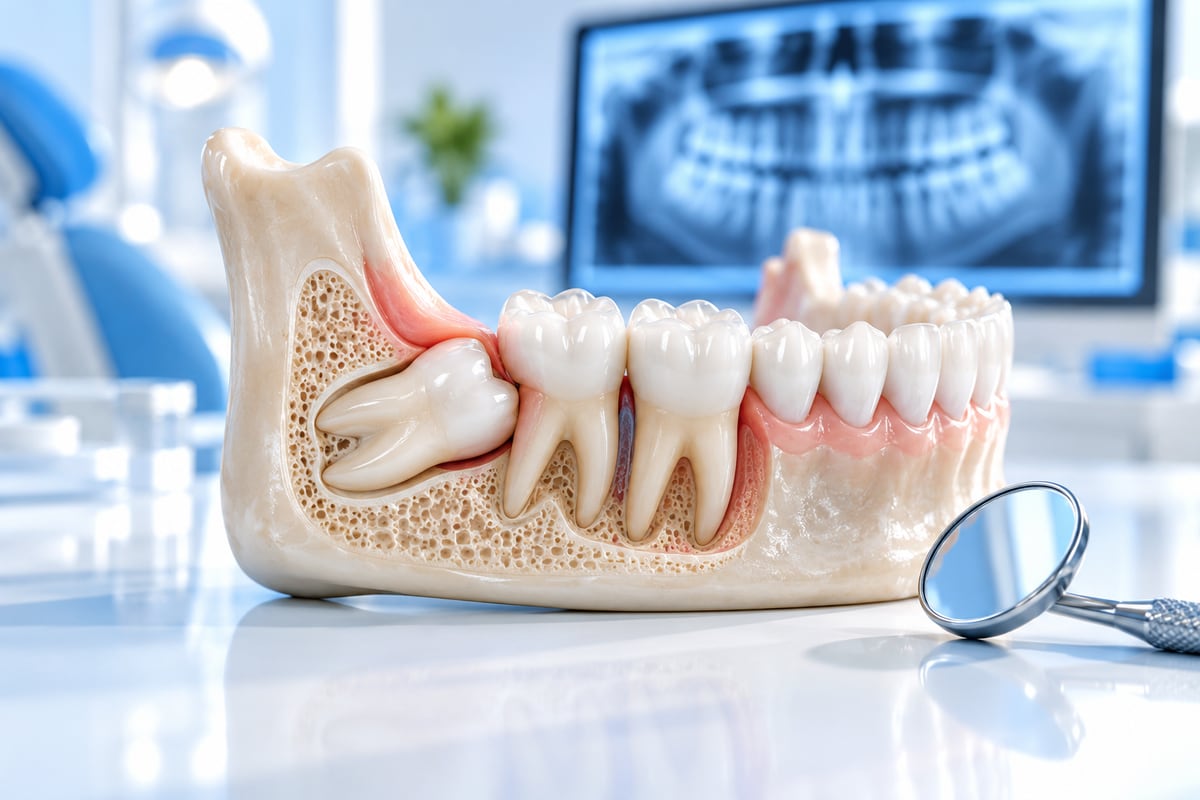
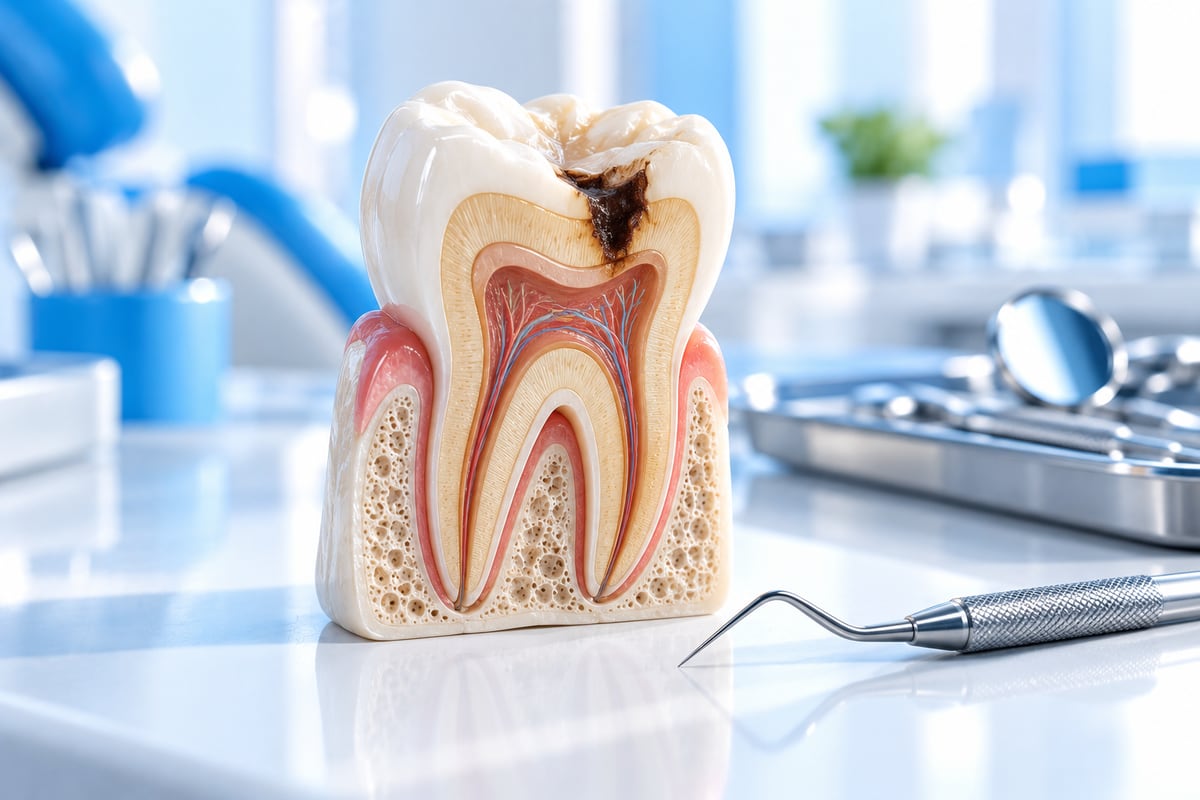
Tooth decay is one of the most common chronic diseases worldwide and, at the same time, one of the most preventable. Most people understand it in a single sentence — "sugar causes cavities" — which is partly true but hides the full picture, and that is why so many keep making the same mistakes even after cutting back on sugar. This guide explains what actually happens on the tooth surface every day, why early decay can be stopped without a filling, and when a filling or root canal becomes unavoidable.
What really happens on the tooth
Plaque bacteria do not eat the tooth. They metabolise fermentable sugars and produce acid, and when the pH at the surface drops below a critical level, minerals leave the enamel crystals — demineralisation. Afterwards saliva neutralises the acid and returns calcium and phosphate to the surface — remineralisation. This cycle happens several times a day, so decay is not an event but an imbalance. Someone sipping five sweet drinks across the day faces a far greater risk than someone eating a dessert in one sitting.
The five stages
| Stage | What happens | Symptoms | Treatment |
|---|---|---|---|
| 1. White spot | Sub-surface mineral loss, surface intact | None; a dull spot visible when dried | Fluoride and habit change — fully reversible |
| 2. Enamel cavity | The surface collapses | Occasional mild sensitivity | Small filling or sealant |
| 3. Dentine decay | Decay reaches the tubule-rich dentine | Clear sensitivity to cold and sweet | Filling, sometimes with a protective liner |
| 4. Pulpitis | Bacteria and toxins reach the nerve | Spontaneous throbbing pain, worse at night | Root canal treatment and usually a crown |
| 5. Abscess | Infection spreads into the bone | Pain on pressure, swelling, sometimes fever | Drainage and root canal, or extraction |
Causes beyond sugar
Dry mouth removes the natural defence: medications for blood pressure, depression and allergy, mouth breathing during sleep, some autoimmune conditions and head-and-neck radiotherapy all reduce saliva and sharply raise risk. Cleaning quality matters more than duration, because decay starts in fissures, between the teeth and at the gum line — and a brush never reaches between teeth. Fluoride makes enamel more acid-resistant and aids remineralisation. Tooth anatomy and crowding make some mouths mechanically harder to clean. Individual bacterial and salivary differences explain why two people with similar habits have different outcomes. Reflux or repeated vomiting brings stomach acid, far stronger than bacterial acid, onto the teeth.
How decay is detected
- Visual examination after drying — white spots are invisible on a wet tooth.
- Gentle probing, never forceful, which could break a repairable surface.
- X-rays, indispensable for decay between teeth and under old fillings.
- Laser or transillumination aids for questionable fissures.
- Risk assessment, which sets how often you should be reviewed.
Treatment by stage
An intact white spot can genuinely be stopped and remineralised with high-fluoride paste, in-clinic varnish, calcium-phosphate products and fewer sugar exposures. Once the surface has collapsed, no product rebuilds lost tissue and a filling is the only option — delay simply makes the filling larger. When decay reaches the nerve, root canal treatment saves the tooth; when too much structure is lost, a crown protects it, and if there is not enough left, extraction with a planned replacement becomes the realistic choice.
Filling materials
| Type | Advantages | Drawbacks | Best for |
|---|---|---|---|
| Composite (tooth-coloured) | Aesthetic, bonds to the tooth, conservative preparation | Needs good isolation and more chair time | Front teeth and most posterior cases |
| Amalgam | Durable, inexpensive, long track record | Unaesthetic, requires more tooth removal | Limited use today |
| Glass ionomer | Releases fluoride, bonds chemically | Less wear-resistant | Children's teeth, temporary and gum-line restorations |
| Ceramic inlay/onlay | High precision and durability | Two visits, higher cost | Large losses beyond a direct filling |
Can decay be treated without a filling?
Yes for a white spot or superficial lesion whose surface is still intact — fluoride, remineralising products and fewer sugar exposures genuinely stop and reverse it. No for an actual cavity: enamel is a non-living tissue with no cells to regrow, so nothing rebuilds lost structure. Be sceptical of any product promising to "heal cavities naturally".
Recurrent decay under fillings
Decay around an existing restoration usually starts at the margin where the filling meets the tooth. Daily interdental cleaning around restored teeth, attention to food repeatedly trapping in the same spot, and regular X-rays — since decay under a filling is invisible to the eye — are what keep restorations serviceable.
A prevention plan that people actually follow
- 1 Brush twice daily with fluoride toothpaste, most importantly before bed, and spit without rinsing heavily.
- 2 Clean between the teeth once a day, at whatever time you will genuinely keep to.
- 3 Group sugars with meals rather than spreading them through the day.
- 4 Drink water after anything sweet or acidic.
- 5 Do not brush immediately after acidic drinks — wait about half an hour.
- 6 Use xylitol gum after meals when brushing is not possible.
- 7 Review medications if you have persistent dry mouth.
- 8 Check-up and cleaning every six months, or every three months if you are high risk.
Sensitivity: decay or something else?
Cold sensitivity is often assumed to be decay, but the causes differ and so do the treatments. Gum recession exposes root surface with no enamel covering; acid erosion from fizzy drinks, citrus or reflux leaves shiny flattened surfaces; grinding creates micro-cracks and widespread sensitivity in several teeth at once; a recent filling or a scaling visit causes temporary sensitivity that settles in days. Genuine decay usually affects one specific tooth and reacts to sweet as well as cold. Treatment begins with the diagnosis: desensitising paste used consistently, in-clinic fluoride varnish, a softer brush and better technique, and a night guard where grinding is involved — but no paste helps if the cause is a cavity or a fracture.
Decay in older adults
The pattern changes with age. Teeth may be strong, but receding gums expose root surfaces that are far softer than enamel and decay much faster. Add the many long-term medications that reduce saliva — for blood pressure, heart, depression, allergy and sleep — and the first line of defence weakens. Arthritis or reduced vision make precise brushing harder, where an electric brush genuinely helps, and old crowns and bridges create margins that trap plaque. The practical answer is prescription-strength fluoride toothpaste, regular varnish, saliva substitutes and review every three months rather than six. Losing teeth is not an inevitable part of ageing — teeth are lost to preventable disease, not to years.
Diet: what protects and what harms
Sticky sugars that cling to teeth prolong exposure far more than sugars that clear quickly, and a sweet drink sipped slowly is worse than the same amount drunk at once. Refined starches such as crisps and biscuits break down into simple sugars and lodge in fissures, so they are no safer than sweets. Acids are a separate threat: fizzy drinks — including diet versions — citrus juices, vinegar and sports drinks erode enamel chemically regardless of bacteria, so have them with meals, rinse with water afterwards and wait about half an hour before brushing.
- Cheese, milk and unsweetened yogurt supply calcium and phosphate and help neutralise acid.
- Unsweetened nuts stimulate saliva and provide minerals.
- Crunchy vegetables increase saliva flow and lightly clean surfaces.
- Water is the best drink for teeth; a glass after meals dilutes acid and washes away debris.
- Xylitol gum after meals stimulates saliva and reduces cariogenic bacteria.
Fissure sealants: the cheapest prevention, and the most neglected
Molar chewing surfaces are not flat; they are covered in grooves, some narrower than a single toothbrush bristle. Those areas cannot be cleaned mechanically however hard you try, and that is exactly where most decay starts in children and teenagers. A sealant is straightforward: the surface is cleaned and dried, a resin flows into the fissures and is light-cured, turning grooves into a smooth, cleanable surface. No drilling, no anaesthesia, no pain, and only minutes per tooth. The ideal timing is as soon as the first permanent molar erupts around age six, and the second around twelve. It is reviewed at each check-up and easily repaired — and it protects the chewing surface only, so it never replaces brushing and flossing.
When decay can be monitored instead of filled
Your dentist may say a small lesion will be monitored rather than filled. That is not negligence but evidence-based, non-operative management of early decay. It requires three conditions: the lesion is early and has not broken through the surface, the patient can clean the area and follow a fluoride plan, and regular radiographic review is possible. In practice that means high-concentration topical fluoride, changes to sugar habits, better interdental cleaning and sometimes resin infiltration. If follow-up shows progression or surface breakdown, a filling becomes necessary. The benefit is preserving tooth structure: every filling, however small, will need replacing eventually, and each replacement removes a little more tooth.
Interproximal decay: the hidden problem
Decay between the teeth is the type most often found late, simply because it is invisible. You cannot see it in a mirror and do not feel it until it reaches dentine. The direct cause is not cleaning between the teeth, since a brush never reaches those surfaces. Early signs include food repeatedly packing between the same two teeth after meals, or floss that shreds in the same place each time — a practical sign of a sharp edge or a cavity. Bitewing radiographs are the only reliable way to detect it, and treatment usually requires access through the chewing surface, making the restoration larger than the lesion. One minute of flossing a day prevents almost all of it.
Frequently asked questions
What is the first sign of decay?
A dull white spot visible after drying the tooth, usually painless. At this stage it is fully reversible with fluoride and habit changes.
Can a cavity heal by itself?
A white spot can remineralise; an actual cavity cannot. No product rebuilds lost enamel.
Why do I get decay despite brushing?
Common reasons: not cleaning between the teeth, frequent sugar exposures, dry mouth from medication or mouth breathing, deep fissures, or recurrent decay at an old filling margin.
Is a filling painful?
No, it is done under local anaesthesia. Mild cold sensitivity for a few days is normal; pain on biting usually means a slightly high filling that takes minutes to adjust.
How often do I need X-rays?
Your dentist decides based on your risk — commonly every one to two years for low-risk adults and more often with active decay.
The bottom line
Decay is not fate or bad luck; it is the outcome of a daily balance between what the tooth loses and what it regains. Every small habit tips that balance — a sweet drink sipped over an hour, or two minutes of brushing before bed. And the stage at which everything can still be fixed without drilling is precisely the stage at which you feel nothing, which is why regular check-ups are the only real chance to catch it while it is still reversible.
This article is general information for education only and does not replace an examination and diagnosis by a dentist. Every case is different, and the right treatment is decided by your dentist after an examination.
Have a question about your own teeth?
Book an examination at Dental Arts and the dentist will check your teeth and calmly explain the options that suit you.