Teething is a stage every child goes through, yet it remains surrounded by myths and anxiety. One parent blames every fever and every loose stool on teething and misses a real infection; another worries because their nine-month-old has no teeth yet, which is entirely normal. This guide separates what teething genuinely causes from what it does not, sets out the full eruption timetable, and explains safe relief and practices to avoid completely.
The eruption timetable
| Tooth | Jaw | Eruption | Shedding |
|---|---|---|---|
| Central incisor | Lower | 6–10 months | 6–7 years |
| Central incisor | Upper | 8–12 months | 6–7 years |
| Lateral incisor | Upper | 9–13 months | 7–8 years |
| Lateral incisor | Lower | 10–16 months | 7–8 years |
| First molar | Upper | 13–19 months | 9–11 years |
| First molar | Lower | 14–18 months | 9–11 years |
| Canine | Upper | 16–22 months | 10–12 years |
| Canine | Lower | 17–23 months | 9–12 years |
| Second molar | Lower | 23–31 months | 10–12 years |
| Second molar | Upper | 25–33 months | 10–12 years |
All twenty primary teeth are usually present by around age three. At about six, the first permanent molar erupts behind the last baby molar without any tooth falling out first — a tooth parents often mistake for a baby tooth and neglect, when it needs immediate protection with sealants and fluoride.
Real symptoms
- Heavy drooling, sometimes with a mild rash around the mouth.
- Biting and chewing on everything, because pressure eases the discomfort.
- Irritability and intermittent crying.
- Localised redness and swelling over the erupting tooth.
- Mildly disturbed sleep for a night or two and a slightly reduced appetite.
- A very slight temperature rise not exceeding 38°C.
What helps, and what to avoid
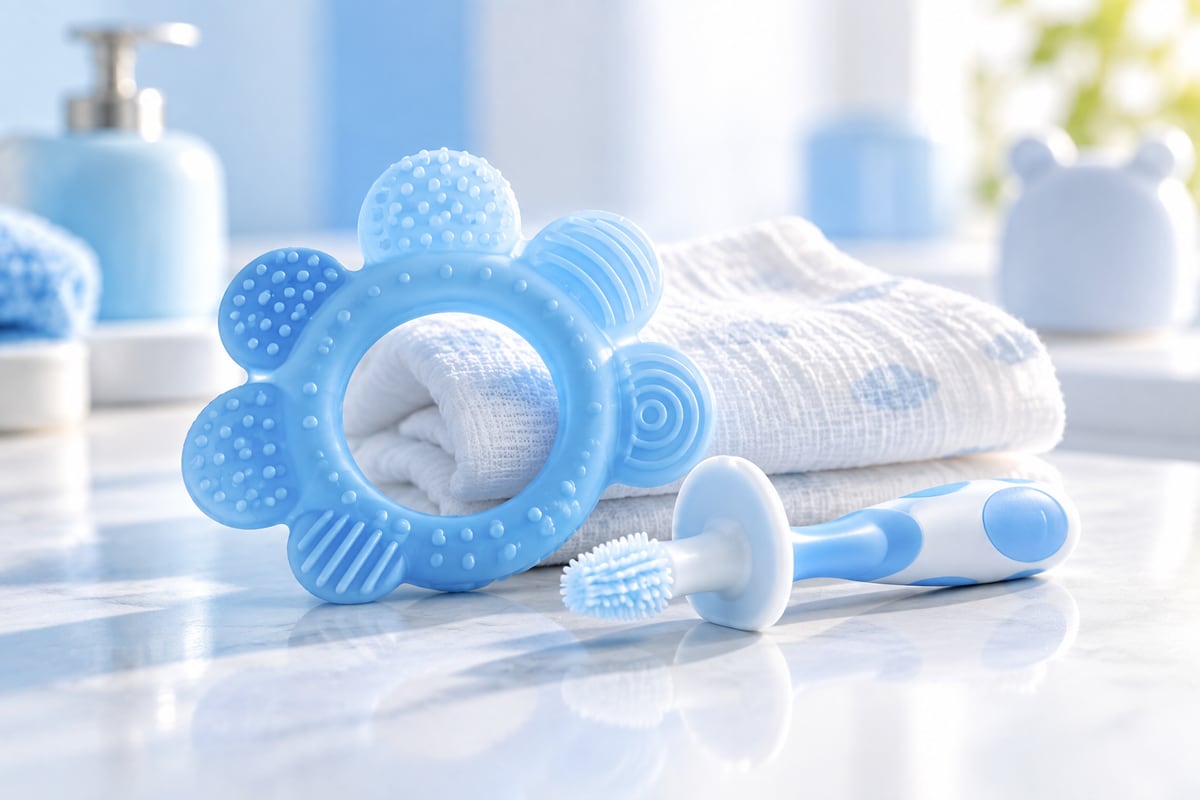
Gum massage with a clean finger, a teether chilled in the fridge (never frozen solid), a cool damp cloth and chilled foods for babies already on solids all help. Paracetamol at a weight-based dose can be used for significant discomfort under medical guidance, not routinely. Avoid amber and other teething necklaces — a documented choking and strangulation risk with no proven benefit — benzocaine gels in infants, honey or sugar rubbed on the gums, and any unlabelled herbal preparation.
Caring for the first teeth
| Age | Tool | Toothpaste | Who cleans |
|---|---|---|---|
| Before teeth appear | Damp gauze or cloth | None | Parent |
| First tooth to 2 years | Very soft infant brush | Rice-grain amount with fluoride | Parent |
| 3 to 6 years | Small child brush | Pea-sized amount | Parent with the child helping |
| 6 to 9 years | Child brush | Pea-sized amount | Child, supervised |
| Over 9 years | Age-appropriate brush | Normal amount | Child, with regular checks |
Early childhood caries shows first as dull white lines along the gum margin of the upper front teeth. The main cause is milk or juice pooling in the mouth during sleep, when saliva flow drops. Never let a baby fall asleep with a bottle, clean the gums or teeth after the last feed, and move to a cup from around twelve months.
The first dental visit
International guidance is clear: the first visit when the first tooth appears, or by the first birthday. The aim is assessment and guidance rather than treatment — and it lets the child get used to the clinic before any procedure is needed. At our pediatric service the first appointment is a short, tool-free introduction with a parent beside the child throughout.
Special situations
A baby occasionally arrives with a tooth already visible, or one appears in the first month. It is usually a primary tooth erupting very early rather than an extra tooth; if it is stable and does not injure the tongue or interfere with feeding it is simply monitored. A small bluish swelling over an erupting tooth is an eruption cyst — alarming to look at but harmless, and it resolves as the tooth comes through. White lines on newly erupted teeth may be incomplete enamel mineralisation or the start of early decay; only an examination distinguishes them, and early fluoride plus feeding changes can stop the process before a cavity forms. Wide spaces between baby teeth are a good sign, since permanent teeth are larger and need that room.
Teething and breastfeeding
Teeth are not a reason to stop breastfeeding. During correct latching the tongue covers the lower teeth, so biting usually happens at the end of a feed when the baby loses interest. Watch for the signs a feed is finishing, and if a bite happens, calmly end the feed and say "no" in a steady voice — a startled shout can frighten the baby or turn it into a game. Offering a chilled teether just before a feed helps on difficult days, and cleaning the teeth after the last night feed matters for breastfed babies too.
The first permanent teeth
Between six and twelve, baby and permanent teeth share the mouth. Newly erupted permanent teeth are especially vulnerable to decay in their first two years, before the surface fully matures. Watch the first permanent molar at age six — the tooth parents most often neglect because they assume it is a baby tooth — and ask about fissure sealants as soon as it erupts. A loose baby tooth is usually left to fall out on its own; if a permanent tooth appears behind one that has not shed, have it assessed. This is also the right age for a first orthodontic assessment, when a narrow arch or bite problem can be addressed simply rather than with longer treatment later — see our orthodontics page.
Teething and sleep
What exhausts parents most is not the discomfort itself but its effect on sleep. Discomfort feels worse at night for two reasons: there are fewer distractions, and lying down slightly increases blood flow to the head and gums. Massage the gums for two minutes right before bed, offer a chilled teether in the last hour rather than only at the moment of waking, keep the bedtime routine consistent, and try comfort before feeding when the baby wakes. Paracetamol at a weight-based dose can be used for a night of significant discomfort under medical guidance — not every night. If disturbed sleep continues for more than three or four consecutive nights, the cause is probably not teething.
Feeding during teething
Many babies reduce solids for a few days and return on their own. Offer cool foods — yogurt, chilled fruit purée, cooked and cooled vegetables — which soothe and nourish at once. Avoid relying on sweet juices or biscuits as a substitute for a meal, never add sugar or honey to encourage eating (honey is unsafe before twelve months), and offer water in a cup from around six months. Complete refusal to eat for more than a day, or signs of dehydration, is not teething and needs medical assessment.
Thumb sucking and pacifiers
Sucking is normal and comforting in the early years and causes no lasting harm. Problems begin when a strong habit continues past about age three: repeated pressure produces an anterior open bite, protruding upper front teeth, a narrow upper arch and sometimes speech effects. Stopping before three or four usually allows partial or complete self-correction. Positive approaches work best — a star chart, gradually shrinking allowed times, an alternative comfort object at bedtime — while scolding or bitter substances usually increase tension and prolong the habit. If a strong habit persists past four, a simple appliance can help break it.
Dental injuries in toddlers
- 1 Check the child's general condition first: loss of consciousness, vomiting or a head injury takes priority over the tooth.
- 2 Control bleeding with gentle pressure using clean gauze.
- 3 Apply a cold compress to the lip or cheek.
- 4 If a baby tooth is displaced, never reposition it yourself — see a dentist the same day.
- 5 If a baby tooth is knocked out completely, do not reimplant it: this can damage the permanent tooth bud beneath.
- 6 A knocked-out permanent tooth is an emergency — hold it by the crown, rinse gently with milk or water, reimplant if possible or store it in milk, and reach a clinic within the hour.
- 7 Watch the colour of the injured tooth over the following weeks; a greyish change may mean the nerve has died.
Fluoride and protecting your child's teeth
Fluoride is among the most evidence-supported preventive measures against decay, yet it worries many parents because of conflicting information online. The science is straightforward: at the correct amount it is safe and effective, and the only documented concern is swallowing excessive amounts during the years teeth are forming — easily avoided by controlling the quantity. Fluoride both strengthens enamel against acid and helps remineralise early white spots before they become cavities, which means correct use can reverse decay at its earliest stage without any filling.
- First tooth to three years: a rice-grain amount of fluoride toothpaste, twice daily.
- Three to six years: a pea-sized amount, teaching the child to spit rather than swallow.
- Do not rinse heavily with water after brushing — spitting alone leaves a longer protective effect.
- In-clinic fluoride varnish every three to six months benefits children at higher decay risk.
- Oral fluoride supplements are only given on a dentist's advice after assessing other sources.
- Keep toothpaste out of a child's reach.
When to see a dentist promptly
- Dull white lines along the gum margin of the upper front teeth — the first sign of early childhood caries.
- Any brown or black spot or visible cavity, however small.
- Swelling of the gum or face, or a white spot on the gum above a tooth.
- Persistent refusal to chew on one side, or repeated complaints of pain.
- A single tooth turning grey after a fall or knock.
- Persistent bad breath despite regular cleaning.
- No tooth at all by eighteen months, or repeated gum bleeding when brushing.
Caught early, these usually need something very simple — fluoride, a small filling, a cleaning. Delayed, the same situation can become pulp treatment of a baby tooth or an early extraction requiring a space maintainer.
Frequently asked questions
When does teething start?
Usually between six and ten months, with a normal range of three to twelve months. Timing is largely genetic and late teething within the first year is not a concern.
Does teething cause fever and diarrhoea?
No. Teething may raise the temperature very slightly, below 38°C. High fever, severe diarrhoea or vomiting indicate another illness and need a paediatric assessment.
Are teething necklaces safe?
No. They carry a documented risk of choking and strangulation with no proven benefit.
My child is one and has no teeth — is that normal?
Usually yes. If no tooth has appeared by eighteen months, a dental assessment and possibly an X-ray are advisable to confirm the tooth buds are present.
Do baby teeth matter if they fall out anyway?
Yes. They support chewing and speech and hold space for permanent teeth; early loss from decay can cause crowding that needs longer orthodontic treatment.
The bottom line
Teething is a normal, mildly uncomfortable stage rather than an illness. What your baby needs is cold, gentle pressure, patience and comfort — not complicated products or inherited remedies. At the same time, never attribute genuine illness to teething. And remember that the first tooth is a starting line: daily cleaning and the first dental visit begin there, and both are a small investment that saves years of treatment.
This article is general information for education only and does not replace an examination and diagnosis by a dentist. Every case is different, and the right treatment is decided by your dentist after an examination.
Have a question about your own teeth?
Book an examination at Dental Arts and the dentist will check your teeth and calmly explain the options that suit you.